
meet the principal investigator:
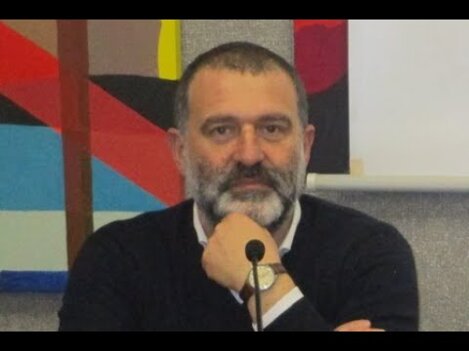
prof. luigi caranti
Luigi Caranti (Ph.D., Boston University) is Professor of Political Philosophy at the University of Catania, Italy.
He has worked as a researcher in various international institutions, including the School of International and Public Affairs of Columbia University, the Australian National University, and the Goethe-Universität Frankfurt.
His studies mainly concern the philosophy of Kant in its theoretical, practical, aesthetic, and political dimensions. Areas of competence are human rights, democratic peace theory and, most recently, digital ethics.
Book publications:
Prof. Caranti authored monographs, including:
- The Kantian Federation (Cambridge Press 2022);
- Kant's Political Legacy: Human Rights, Peace, Progress (UWP 2017);
- Kant and the Scandal of Philosophy (University of Toronto Press 2007);
Additionally, he has co-edited books, including:
- with Fernando Silva, The Kantian Subject: New Interpretative Essays (Routledge 2024);
- with Alessandro Pinzani, Kant and the Problem of Politics: Rethinking the Contemporary World (Routledge 2023);
- with Alessandro Pinzani, Kant and the Problem of Morality: Rethinking the Contemporary World (Routledge 2023);
- with Alessandro Pinzani, Kant and the Problem of Knowledge: Rethinking the Contemporary World (Routledge 2023);
- with Denise Celentano Paradigms of Justice: Redistribution, Recognition, and Beyond (Routledge 2021);
Peer-reviewed Journals:
Caranti has also published in national and international peer-reviewed journals such as The Journal of Political Philosophy, Journal of International Political Theory, Kant-Studien, Theoria, Journal of Human Rights, Philosophy & Social Criticism, Journal of International Political Theory, and Rivista di Filosofia.
EU Projects:
- Prof. Luigi Caranti led the MSCA project KANTINSA – Kant In South America, an EU-funded international research network on Kant (Marie-Curie RISE n. 777786).
Currently, he leads the EU-funded project “JUSTLA – Justice in the XXI Century: A Perspective from Latin America” (MSCA 101183054), with 18 universities and 150 researchers.